I really enjoyed reading the Appendix of Frederick Douglass' narrative as he brings the ideas of Christianity to another light. A light in which has been dimmed by the South. Frederick discusses a wide range of "heavenly unions" in his writing titled A Parody.
I really see this piece of writing as almost like slam poetry. The rhymes and emphasis on words very raw and rigid, and can be argued as slam poetry. It may even bring me to the thought of this may have been the start of written.
“Come, saints and sinners, hear me tell
How pious priests whip Jack and Nell,
And women buy and children sell,
And preach all sinners down to hell."
Its crazy to see and hear his rhyme scheme. He adds a very 1800 century flow to his poem. The
“They’ll read and sing a sacred song, And make a prayer both loud and long,
And teach the right and do the wrong,
Hailing the brother, sister throng,
With words of heavenly union.
I believe that the "Heavenly Union" is for emphasis on his belief in Christianity. To bring focus of Fredrick's narrative this piece of writing depicts his views of Christianity of slavery. The abuse of African Americans by their "owners". It was an interesting perspective.
Thursday, February 19, 2015

Wednesday, February 18, 2015
ENG130 Group 2: Standards of Beauty
ENG130 Group 2: Standards of Beauty: The standards of beauty that we know today are at the extremes. You’re either a size 2 and perfect or anything else and flawed. Girls start...
here's my comment because technology hates me. Enjoy!
I like that you start out with how the media portrays beauty today in your discussion of "The Birthmark." Although one thing that comes to mind, if Georgiana, in the eyes of everyone except Aylmer, is truly the perfect woman and the birthmark enhances her beauty, what does that say about Aylmer? Does it mean that he is maybe that force behind the media that constantly drives the beauty standards higher and higher? Or maybe even the idea that these models who are so beautiful are also photoshopped and can't even live up to the standards that exist. I also wonder if it could even represent the push for stars and models to get plastic surgery and become ever more "perfect." I think that could also tie into an argument for the nature versus science aspects of the story and how in our natural state, we can never truly be "perfect" and that perfection is not real and what is real is imperfect.
here's my comment because technology hates me. Enjoy!
I like that you start out with how the media portrays beauty today in your discussion of "The Birthmark." Although one thing that comes to mind, if Georgiana, in the eyes of everyone except Aylmer, is truly the perfect woman and the birthmark enhances her beauty, what does that say about Aylmer? Does it mean that he is maybe that force behind the media that constantly drives the beauty standards higher and higher? Or maybe even the idea that these models who are so beautiful are also photoshopped and can't even live up to the standards that exist. I also wonder if it could even represent the push for stars and models to get plastic surgery and become ever more "perfect." I think that could also tie into an argument for the nature versus science aspects of the story and how in our natural state, we can never truly be "perfect" and that perfection is not real and what is real is imperfect.
engl130team5: The Placebo Root
engl130team5: The Placebo Root: Have you ever heard the story of some frat that was given kegs full on non-alcoholic beer, but were unaware of it? Well, the memb...
So for some reason I can't actually post comments under the actual blog posts, so here is my comment in response to this post and I'll probably end up continuing to do this until I figure out why technology hates me so much :(
I was thinking similar things during your presentation yesterday. I feel like it's kind of like in The Big Bang Theory how Raj can only talk to women when he's drunk. There's one episode when all the characters are on a train and Raj is drinking non-alcoholic beer (though he doesn't realize it), so he's able to talk to this woman that all the main guys are interested in - until Howard points out that it's non-alcoholic beer. When he realizes this, he freezes up and can;t talk to the girl anymore even though he could before.
I think it may be a similar case with Douglass. I also believe there were other factors that played into his standing up to Mr. Covey, but I think the possibility of the root working gave him the little boost he needed to do what he needed to do. It then makes me wonder if anything after that incident would have happened if he had not been given the root or if it was one of those things that would have happened no matter what - like if it wasn't the root, it would have been something else like a pebble.
The discussion on this point yesterday also made me think for a moment if it was a literal root from the ground or if Douglass was using that as a different name for something else kind of like how he skipped over the exact details of his escape to protect others.
So for some reason I can't actually post comments under the actual blog posts, so here is my comment in response to this post and I'll probably end up continuing to do this until I figure out why technology hates me so much :(
I was thinking similar things during your presentation yesterday. I feel like it's kind of like in The Big Bang Theory how Raj can only talk to women when he's drunk. There's one episode when all the characters are on a train and Raj is drinking non-alcoholic beer (though he doesn't realize it), so he's able to talk to this woman that all the main guys are interested in - until Howard points out that it's non-alcoholic beer. When he realizes this, he freezes up and can;t talk to the girl anymore even though he could before.
I think it may be a similar case with Douglass. I also believe there were other factors that played into his standing up to Mr. Covey, but I think the possibility of the root working gave him the little boost he needed to do what he needed to do. It then makes me wonder if anything after that incident would have happened if he had not been given the root or if it was one of those things that would have happened no matter what - like if it wasn't the root, it would have been something else like a pebble.
The discussion on this point yesterday also made me think for a moment if it was a literal root from the ground or if Douglass was using that as a different name for something else kind of like how he skipped over the exact details of his escape to protect others.
A Voice for the Victims
I wanted to take another look at the scene with Aunt Hester
because I think this scene illustrates those things which we really don’t want
to remember or even acknowledge to have actually happened and be a part of our
history. It’s common knowledge that slavery is a horrible thing that
dehumanizes people to the point where it would be better if they were merely
beasts of burden as their masters believe them to be. But they aren’t. They are
people with blood and a voice.
Those two
things are what make the section with Aunt Hester so hard to stomach. We can
confer Mr. Plummer’s beatings of her are a regular occurrence based on Douglass’
description of how he would “whip upon her naked back till she was literally
covered with blood […] He would whip her to make her scream, and whip her to
make her hush” (2). This is the moment where we see the lust for power over
someone else that is at the heart of what slavery is. Mr. Plummer’s goal on a
daily basis is to draw blood and take away Hester’s voice and only allow it to
come forth when he wants it.
This is
even more prevalent on the following page when Douglass shows us what he saw on
the day that he entered “the blood-stained gate, the entrance to the hell of
slavery” (2). I think what touches me most deeply about this scene is how
Douglass’ language makes the sight and sounds appear the way it would be if it
were rape. He slows down the scene and begins, not with the actual act of the
whipping, but the events which lead up to it. Mr. Plummer “took her into the
kitchen” (3). For me, the word “took” doesn’t necessarily sound excessively
forceful as compared to “he dragged
her into the kitchen” – no, he took her.
He then “stripped her from neck to waist, leaving her neck, shoulders, and
back, entirely naked” (3). Now it starts to sound more forceful because he stripped her from neck to waist and it sounds as though she were not a person
but a piece of wood that needs to be filed down and rid of its rough edges.
except her doesn’t uncover her completely – he leaves her bottom half covered
because all he seems to care for is the soft, scarred flesh of her back.
The tension
continues to build as Douglass describes how Mr. Plummer “made her get upon the
stool, and tied her hands to the hook […] Her arms were stretched up at their
full length, so that she stood upon the ends of her toes” (3). He made her – whether she wanted to or not,
she had no choice – and her arms were stretched
so that she stood upon the ends of her
toes. Everything about this image is tense, and we see her hanging there
like a piece of meat that is about to be stripped of its skin to expose the
muscle and bone beneath – which is what is about to happen to her, and we already
know it just from this image.
And then it
hits us. “[H]e commenced to lay on the heavy cowskin, and soon the warm, red
blood […] came dripping to the floor” all while we hear “heart-rending shrieks
from her” (3). At this point in our lives, almost everyone knows what blood
looks like, and we see it here the same as anywhere else we would see it – warm
and red, dripping to the floor – and we
hear the pain in Aunt Hester’s voice. It’s the same here as it would be if it
were a white woman that this were happening to, yet it makes no difference to
Mr. Plummer because to him, she’s just an animal that he’s strung up and,
somewhat ironically, using another beast’s skin to punish her. This scene shows
us how she is dehumanized in Mr. Plummer’s eyes very similarly to how a rape
victim is not seen as being another person in the eyes of their rapist.
With this
interpretation in mind of how the way the scene portrays her as being a piece of
livestock that’s been sent to a slaughter house, I think the scene is
justifiably graphic. In some ways, yes, it may humiliate her further but
considering the way that she had been dehumanized as she is, what further
damage could she sustain by being seen as she is here. She is a woman who is
being punished and treated in a manner which takes away any opportunity for her
to be seen as belonging to that domestic sphere which is so essential to this
time period. What else could be done that could harm her more than what has
already happened to her?
To be honest, reading this scene
wasn’t the hard part because I have a tendency to distance myself from the
speaker and characters when reading a piece of literature in order to analyze
it better. Trying to write about it and convey my feelings about the scene
without becoming nonsensical is the hard part – that is, I want what I’m trying
to say to make sense without my emotions getting in the way too much. Which is
hard because this is a topic which I have very strong feelings about because,
as a writer myself, the thought of having my voice being taken away from me is
the worst possible end. I think that’s the reason why Douglass learning to read
and write was so vital to his salvation.
“Go’way”
First
of all, wow, I did not except this story to start nor end the way it did. [Just FYI if you haven't read "In the Land of the Free," you definitely should cause spoilers, so you've been warned.] I
feel like the title, “In the Land of the Free” somehow lied to me. When I think
land of the free I don’t really think of someone’s child being taken away from
them, I just think America. Personally, I felt like this story was heartbreaking.
A mother and her son are finally reunited with dad who hasn’t met their son,
and the kid gets taken away! [See spoilers]
I think what hit me the hardest in
this tale was the end. After ten months of separation between mother and son to
hear your child say, “Go’way” must be heartbreaking (Far 101). A mother’s love
is unconditional and when Lae Choo heard these words come out of her son’s mouth
it must have felt like a stab to her heart. She probably felt that her title of
mother was taken from her by the missionary woman who took care of her son when
she was unable to. Not because she didn’t want to take care of her son but
because he didn’t have the proper paper work to allow him entry into the United
States.
That last scene made me feel like she was a complete
stranger to her son. “But, the Little One shrunk from her and tried to hide
himself in the folds of the white woman’s skirt.” (Far 101). I don’t get the
feeling that the little boy was just being shy, but maybe a little afraid
because he didn’t recognize her? When he is hiding from his mother she is on
her knees with her arms stretched towards her son (Far 101). I’m not a mother,
but I feel like that would feel awful. You carry someone with you for nine
months, and you care for them after their born, you love them, and to have them
not connect with you? Yikes. That’s all the author leaves us with too, the son
telling his mother to go away. We don’t know what happens afterwards, which
really bothers me. Like I want to know that they’re okay. That eventually the
little boy and his family were able to gradually connect again, but I will
never know. Maybe this was a way for the author to allow the reader to come up
with their own ending, be confused, or face the reality of what happens when
separated loved ones are reunited. I don’t know, but I really wish I got some
closure!
It’s sad to think that immigrant
children are probably taken from their parents by customs officers more often
then we think. “There cannot be any law that would keep a child from its
mother!” (Far 96). Sadly though, this story illustrates that somehow there are
laws (at least at this time) that did separate a child from its mother. In this
case, there was no proof that Lae Choo or her husband were his birth parents. This
scenario doesn’t just apply to children though, I’ve known parents separated
from their children because they’re illegal immigrants and their children born
here in the United States. It probably doesn’t feel like the land of
opportunity, or the land of the free when your family is torn apart.
Monday, February 16, 2015
The Placebo Root
Have you ever heard the story of some frat that was given kegs full on non-alcoholic beer, but were unaware of it? Well, the members of the frat believed it to be normal good ol’ beer and acted as though they were drunk, some, even threw up. This is the placebo effect; a simulated treatment or medication to deceive whomever receives it.
Though this may not be directly related, this is how I thought of the “root” that was given the Frederick Douglass by another slave, Sandy Jenkins. “He told me… I must go with him into another part of the woods, where there was a certain root, which, if I would take some of it with me, carrying it always on my right side, would render it impossible for Mr. Covey, or any other white man, to whip me (111).” This root received by Douglass was the object that allowed him to stand up to Covey, altering his situation and essentially foreshadowing the freedom that was coming to him. Before lashing out against Mr. Covey, Douglass states, “On this morning the virtue of the root was fully tested (112).” Douglass firmly believed that the root was responsible for his actions, which is what I believe too. Although it did help him in standing up to his master, I think it could be considered as a placebo. Just like the example of giving a person beer and telling them that it will get them drunk, even though there is no alcohol in it. I don’t wan’t to say that Douglass had a false sense of courage, but I will say that his courage was probably inflated, because he thought he was protected by this root. What would have happened if Sandy Jenkins and the root never crossed Douglass’s path? Perhaps his whole narrative would have been altered, and he could have been under the reins of Mr. Covey, having never stood up to him.
I think that Douglass’s courage in this scene should be attributed to much more that the root that was in his right pocket. We learn through his narrative that Douglass was a remarkable and intelligent man that fought his way out of slavery. He may have thought that the root gave him superstitious powers to fight back against Covey, but at the end of the day, he was just taking the word of another slave that happened to persuade him.
Is Babo was a symbol of the Devil?

Francisco is described as a "rajah-looking mulatto" with a turban. He is very sophisticated and kind as Captain Delano would describe as "your steward here has features more regular than King George’s of England" (Herman Melville 46). Captain Delano was suspicious of this "mulatto" character. He even referred to his origins as the devil himself.
“Don Benito,” whispered he, “I am glad to see this usher-of-the-golden-rod of yours; the sight refutes an ugly remark once made to me by a Barbados planter that when a mulatto has a regular European face, look out for him; he is a devil." (Herman Melville 46)
However, this may have been a constructed bias on Captain Delano's behalf. Assuming that Francisco is trying to plot something because of his well-mannered behavior. Francisco was both white and black, which places a constructed idea which Captain Delano and most people are instilled with today; that being Black is immoral. These social construct brings the reader to assume both Babo and Francisco are one in the same generalizing the readers ideas.
"a display of elegance which quite completed the insignificance of the small bareheaded Babo, who, as if not unconscious of inferiority" (Herman Melville 46
The mentioning of Babo by Captain Delano, brings the reader to group Babo with Fransisco.
Thursday, February 12, 2015
Wade in the Water
“While
on their way, they would make the dense old woods, for miles around, reverberate
with their wild songs, revealing at once the highest joy and the deepest
sadness.” (Douglass 57). I’ve always known that singing was something that
slaves did, but I never really thought about it until Frederick Douglass
started talking about it. I honestly thought it was something just to pass the
time away and maybe escape from their terrible situations. Maybe it was, but
Douglass does point out that these songs were means of communication. “This
they would sing, as a chorus, to words which to many would seem unmeaning
jargon, but which, nevertheless, were full of meaning to themselves.” (Douglass
57).
So how I see it is no one would
understand what you were saying unless they were in on it. Slave owners and
people in the North most likely didn’t understand the purposes of these and
misinterpreted them. Douglass even says, “The mere hearing of those songs would
do more to impress some minds with the horrible character of slavery” (57). The
overseers hearing the songs would see the exact opposite of what the slaves
were feeling. These songs probably sounded cheerful, but these people were
definitely not in a happy place in their lives. These songs often expressed
their true feeling and were one way that the slaves could actually express
themselves. “They [the songs] told a tale of woe which was then altogether
beyond my feeble comprehension, they were tones loud, long, and deep…”
(Douglass 57).
After reading this chapter from Douglass’ Narrative I went online and I searched
for some of these songs. I didn’t find too much, but there was one song that I
kept running into was “Wade in the Water.” It’s a song that some believe was a
way to communicate to escaping slaves. It was a way to tell them to get off the
trail and into water so that dogs couldn’t follow their scent trail. Apparently
it’s a debatable subject whether or not some of these songs were used to relay
information, but it makes complete senses to me if there was really no other
way to distribute this information without severe punishment.
Wednesday, February 11, 2015
Satyrs - okay, but why?
So I don’t know about you guys, and maybe it was just the
time and how I was feeling when I decided to pick up “Benito Cereno” and read
it like I was supposed to, but I had trouble really getting into the groove of
it despite it being pretty interesting. But as I was struggling to get through the
first few pages of the story, what caught my attention the most was the
stern-piece and the crest that was carved there. Delano describe the arms and
the “mythological or symbolic devices” it used – namely the “dark satyr in a
mask, holding his foot on the prostrate neck of a writhing figure, likewise
masked” (164).
Now, a lot
can be inferred from this image, but the question that has been bothering me the
most is WHY IT WAS A SATYR. Of all the creatures he could have used (a person,
for example), why this mythological beast? I’ll admit, when I was but a wee
one, I was SUPER into Greek mythology and really any type of mythology to be
honest. But from what I remembered Satyrs being like, it didn’t make any sense
from my present knowledge of them.
So I did some
digging:
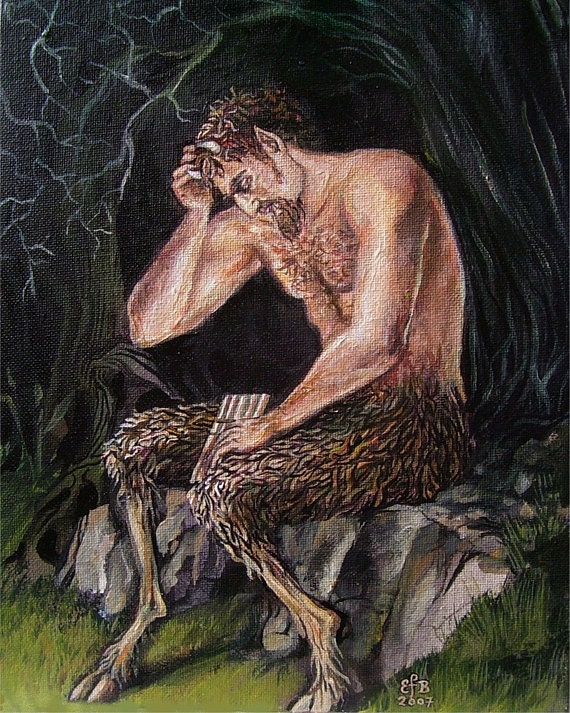 |
| Source :https://img0.etsystatic.com/000/1/5124363 /il_570xN.277056348.jpg (Also, SO MANY sexualized images of satyrs when I googled it - much manhood, many compensation) |
According
to the Encyclopedia Brittanica, Satyrs are nature spirits and are part human
and part beast (usually a goat or horse) and are also associated with Dionysus –
a nature god of fruitfulness and vegetation, but mainly known as the god of
wine and ecstasy (or if you watch Game of Thrones, the god of tits and wine
which Tyrion refers to himself as at one point). In the Satyr Play (a Greek
drama genre), they are used to contrast with the main characters – who are
usually serious – by their dancing, love of wine, and diverting banter “often
expressed in low language” (potty humor – they also usually have erect penis’
so what does that tell you?). They also generally are thought to embody the
wild, uninhibited forces of nature and were often depicted as being entranced
with nymphs as the object of their affections and as a result have a reputation
of naughtiness.
So, now we
come to the image on the stern-piece and what it all means. First, we can
assume that because the satyr’s foot is on the neck of a “writhing figure,” it
represents a master and subservient relationship of some kind in which the
master subdues those under him into submission by use of force (which makes
sense since we are assuming this is a slave-ship). Next, we have the detail of
the figures both wearing masks. Masks can have many meanings depending on the
context, but the most common one is that it hides the identity and emotions of
the wearer. So in this situation, not only is the face of the master hidden,
but the face of the subdued. As a result, we have this blindness on the part of
who the master is which could mean that it doesn’t matter who it is exactly
because as long as they have power over you, there’s nothing you can do to stop
it. We also have this situation of the one being subdued wearing a mask which
could be a thing of the heart not being able to feel what it can’t see – so as
long as I can’t see that I’m hurting you or who you are or even that you’re
another person, then I don’t have to feel bad or think twice about my actions.
But it could also be similar to the master thing except that it doesn’t matter
who it is that I’m oppressing because I will conquer anyone.
How do
these two images work with the reputation of the satyr? Well, here’s my theory,
and I’d like to see what you guys think because I’m not sure if it works that
well or not:
So we know
that the satyr is associated with mischief to a certain extent, and the image
of the stern-piece is described as “a dark satyr,” so what if this is supposed
to be a usually light-hearted creature gone to the dark side? If we assume that
the satyr is a prankster, then since it’s wearing a mask, it may be using that
as a way of hiding its identity because whatever prank it is, is seen as more
harmful. Not only this, but since the mask hides emotion and satyrs also embody
the wildness of nature in its true form, all previous inhibitions it may have
had are gone and the creature is merely doing as the animals would. We could
then say, that since this is a slave ship, it means that in the natural order
of things, when we let go of our inhibitions and worries about what could be
seen as bad in our actions, there is a master and those who serve him and who
are punished if they step out of line, and could then be an argument for
slavery.
Follow who?
Written by Herman Melville, Benito Cereno is a tale that is full of symbols. We read the story from Captain Delano’s perspective, and through his eyes we enter onto the mysterious ship named “San Dominick”. However, through this limited point of view, we only get to see Delano’s perception. Later, we realize that Delano was deceived, and his perception of the ship was not at all what he had presumed it was.
A prominent symbol in the story is the ship itself, that drifts into Delano’s waters off of the coast of Chili. As a man of “a singularly undistrustful good nature (162)” Delano boarded the ship, despite it not having a flag, and not knowing who was on it. As described by Melville, the ship was in terrible condition. “Battered and mouldy, the castellated forecastle seemed some ancient turret, long ago taken by assault, and then left to decay (164)” The physical state of the symbolizes that it is not under its rightful ownership. Although the ship has damage from being stranded at sea for some time, a captain would have tried to keep the ship in good condition.
Later it is revealed that Babo and Atufal had murdered the captain of the ship, Alexander Aranda, and hung his skeleton at the front, under a canvas. “Rudely painted or chalked, as in sailor freak, along the forward side of a sort of pedestal below the canvas, was the sentence, “Seguid vuestro jefe, (165)” This phrase meaning “follow your leader” poses confusion for the readers. The captain of the ship is dead, and from Delano’s perspective we are under the assumption that Benito Cereno is the leader of the ship. But, after many strange occurrences, we begin to question this. It is possible to believe that Babo is in fact the leader of the ship. The fact that Melville chooses to describe the sentence as “rudely painted or chalked, as in sailor freak (165)” suggests that this message could have been written by Babo, as a reminder to all of his shipmates that he is the man in charge.
The fact that this whole tale is a charade makes me believe that Babo is the true leader that the crew was following. He had Benito wrapped so tightly around his finger, that he followed through with acting as the captain of the ship. Through Delano’s naive eyes we are unable to see what is truly happening, until Benito jumps off of the ship and Babo goes after him with a knife. Basing our ideas on one persons perception can lead us astray and distract from the reality of a situation.
Tuesday, February 10, 2015
The Birthmark
 There is one thought that has been
forged in my mind about The Birthmark by Alfred Kazin, which is that this story
described the destruction of Earth by the hand of man. In the pursuit of
modernization, people will use the technology they possess to push forward in
their endeavors for perfection but inter will kill the very thing that would
help them every step of the way, Earth.
There is one thought that has been
forged in my mind about The Birthmark by Alfred Kazin, which is that this story
described the destruction of Earth by the hand of man. In the pursuit of
modernization, people will use the technology they possess to push forward in
their endeavors for perfection but inter will kill the very thing that would
help them every step of the way, Earth.
The symbolism in the main
characters is key; Aylmer the husband clearly stands for science, but can also
industrialization and civilization. However, Georgina can be a symbolic for
Earth or Mother Nature. "you came so nearly perfect from Nature. . .
"(Nathaniel Hawthorn 85) Her close resemblance of nature is placed to
makes the audience think of her beauty as of nature or organic so Earthly.”. .
.that this slightest possible defect, which we hesitate whether to term a
defect or a beauty, shocks me, as being the visible mark of earthly
imperfection." (Nathaniel Hawthorn 85) The obsession of man in
transforming landscapes and nature into beauty is something that makes people
wonder why.
"Perhaps removal may cause carless
deformity; or it may be the strain goes as deep as life itself." (Nathaniel
Hawthorn 87)The obsession in making things perfect on Earth even if it may
cause fatal disasters such as Global Warming that are hard to remove after so
much pollution. Transforming nature with industry, modernization, and the
creation of cities and modern entities will cause people to think they are
doing the best interest of Earth when it will cause death like the fall of
Georgina.
Wednesday, February 4, 2015
Discomfort is our Reality
No one wants to talk about it. The suppression or exclusion we feel as human beings. The built up angst, the words that seem harmless but actually hurt. The discomfort that we live through everyday just to seem normal too our peers.
I grew up in discomfort. However, this concept had never crossed my mind until Claudia Rankine brought to my attention the endless encounters happening everyday that make us feel unsettled. Growing up in a town where my sisters and I stuck out because our hair and skin didn’t match the majority of the population, the signs of discomfort were all around us.
My sisters and I were subjected daily to the pulls and grabs of our curly hair which came along with comments like, “Why is your hair like that and mine isn’t?” To which my answer always consisted of an uneasy smile and a slight shrug of the shoulders. This reminded me of when in the text, Rankine describes the person at the cashier thinking to herself, “What is wrong with you?” after being asked if she thinks that her card will work (54). The woman that was simply trying to purchase her lunch was put into that area of discomfort, and internalized her feeling of being exiled. What is so different about me, and why didn’t you ask the person in front of me the same question? It is a discomforting thought to have, to think about how other people perceive you, yet one that crosses our minds far too often.
Another encounter with discomfort occurred while I was away at a leadership camp. We split into groups of twos and had to tell our partners something that they would have never guessed about us. I said to the boy sitting across from me, “I’m Panamanian and Jamaican,” feeling rather proud of my Caribbean roots. Without asking me to clarify or explain, he abruptly turned around to the rest of the group and shouted, “This girl is Pandamanian, I’ve never heard of someone being that before!” Filled to the brim with embarrassment, I did not feel like I had the power or the need to correct him. Others were already giggling and I shied away from the situation, internalizing my feelings, and deciding to live with the discomfort.
Whether we admit it to ourselves or not, we try to push down these feelings into an area where they are swept under the rug, hidden from our every day interactions. When in fact, they are always present and always an unwanted visitor in our thoughts.
No one lives in the normal, we all live in the discomfort. This discomfort is our reality.
My sisters and I were subjected daily to the pulls and grabs of our curly hair which came along with comments like, “Why is your hair like that and mine isn’t?” To which my answer always consisted of an uneasy smile and a slight shrug of the shoulders. This reminded me of when in the text, Rankine describes the person at the cashier thinking to herself, “What is wrong with you?” after being asked if she thinks that her card will work (54). The woman that was simply trying to purchase her lunch was put into that area of discomfort, and internalized her feeling of being exiled. What is so different about me, and why didn’t you ask the person in front of me the same question? It is a discomforting thought to have, to think about how other people perceive you, yet one that crosses our minds far too often.
Whether we admit it to ourselves or not, we try to push down these feelings into an area where they are swept under the rug, hidden from our every day interactions. When in fact, they are always present and always an unwanted visitor in our thoughts.
Monday, February 2, 2015
What makes us unique
It’s interesting that Hawthorne chose to write this
short story surrounding a birthmark. Of all the things he could choose from, he
chose a birthmark. It is something that is uniquely tied to one individual, and
a mark that separates us from others. Just the title The Birthmark makes me think of my brother’s birthmark. Why not my
own? Well his birthmark is way cooler to be quite honest the sclera (the white
part) on his eyes are blue. In our family it’s genetic, something Grandma has
and was passed along to my brother, and sadly skipped over me.
I could honestly keep talking about how cool my
brother’s eyes are, but I’ll spare you and go to the text. Unlike my brother,
Georgiana’s birthmark is on her cheek and in the shape of a small red hand
(Which is kind of cool, but not as
cool as my brother’s). As I read through Hawthorne's story I felt that this red handed birthmark was a sign of
death. Hawthorne writes, “it [the birthmark] was the fatal flaw of humanity”
(86). One potential flaw of humanity that comes straight to my mind is the fact
that eventually humans die. Maybe that’s a little dark, but Alymer clearly sees
this birthmark as a sign of imperfection.
Alymer even has a gruesome dream where he tries to
remove Georgiana’s birthmark. “But the deeper went the knife, the deeper sank
the hand, until at length its tiny grasp appeared to have caught hold of
Georgiana’s heart” (Hawthorne 87). The heart is what keeps our blood pumping
and vital to life. Alymer is killing her in his dream as he tries to remove
this imperfection from her body. It doesn’t seem like a great solution though
if Georgiana’s birthmark symbolizes mortality. You can’t necessarily fix one’s mortality.
Maybe Hawthorne isn’t trying to illustrate the idea of fixing death, but rather
that it’s just a cycle of life. The birthmark then becomes a mark of death.
Death happens to everyone, no one can escape it. Even at the end of the text
Georgiana while she loses the small red hand that held her cheek she still
dies.
“The fatal hand had grappled with the mystery of
life, and was the bond by which an angelic spirit kept itself in union with a
mortal frame” (Hawthorne 99). I feel that the mortal frame is of course
Georgiana, and the fatal hand is the symbol of death. When Hawthorne says
“grappled with the mystery of life” (99) is he talking about how life can be a
trial and death inescapable? What is the mystery of life? Life itself? I feel
as if I have witnessed an exchange where in order to remove her birthmark,
Georgiana had to lose her life. Which seems like a totally unfair exchange, but
life isn’t always fair.
To end on a different note here’s a picture of my
brother when he was maybe five years old. It’s the coolest birthmark that I
know of, and now something that will remind me of this short story. Just don’t
tell my brother.
 |
| My brother's cool birthmark. Personal photograph by author. |
Subscribe to:
Comments (Atom)