So I don’t know about you guys, and maybe it was just the
time and how I was feeling when I decided to pick up “Benito Cereno” and read
it like I was supposed to, but I had trouble really getting into the groove of
it despite it being pretty interesting. But as I was struggling to get through the
first few pages of the story, what caught my attention the most was the
stern-piece and the crest that was carved there. Delano describe the arms and
the “mythological or symbolic devices” it used – namely the “dark satyr in a
mask, holding his foot on the prostrate neck of a writhing figure, likewise
masked” (164).
Now, a lot
can be inferred from this image, but the question that has been bothering me the
most is WHY IT WAS A SATYR. Of all the creatures he could have used (a person,
for example), why this mythological beast? I’ll admit, when I was but a wee
one, I was SUPER into Greek mythology and really any type of mythology to be
honest. But from what I remembered Satyrs being like, it didn’t make any sense
from my present knowledge of them.
So I did some
digging:
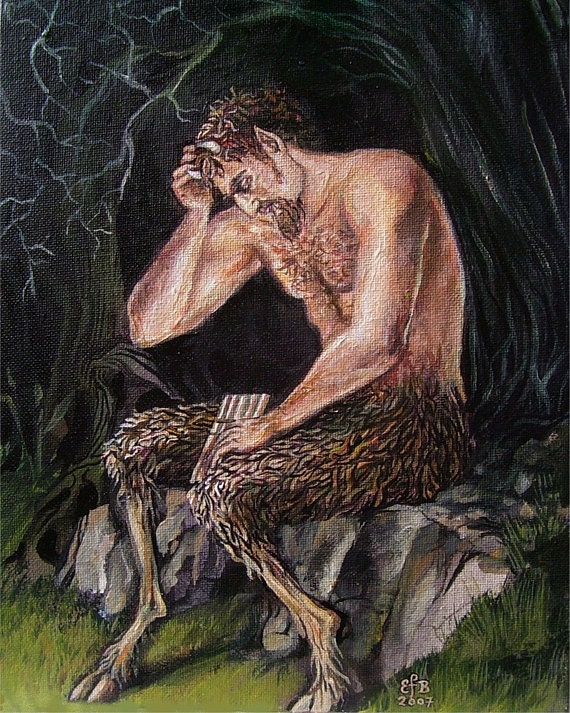 |
| Source :https://img0.etsystatic.com/000/1/5124363 /il_570xN.277056348.jpg (Also, SO MANY sexualized images of satyrs when I googled it - much manhood, many compensation) |
According
to the Encyclopedia Brittanica, Satyrs are nature spirits and are part human
and part beast (usually a goat or horse) and are also associated with Dionysus –
a nature god of fruitfulness and vegetation, but mainly known as the god of
wine and ecstasy (or if you watch Game of Thrones, the god of tits and wine
which Tyrion refers to himself as at one point). In the Satyr Play (a Greek
drama genre), they are used to contrast with the main characters – who are
usually serious – by their dancing, love of wine, and diverting banter “often
expressed in low language” (potty humor – they also usually have erect penis’
so what does that tell you?). They also generally are thought to embody the
wild, uninhibited forces of nature and were often depicted as being entranced
with nymphs as the object of their affections and as a result have a reputation
of naughtiness.
So, now we
come to the image on the stern-piece and what it all means. First, we can
assume that because the satyr’s foot is on the neck of a “writhing figure,” it
represents a master and subservient relationship of some kind in which the
master subdues those under him into submission by use of force (which makes
sense since we are assuming this is a slave-ship). Next, we have the detail of
the figures both wearing masks. Masks can have many meanings depending on the
context, but the most common one is that it hides the identity and emotions of
the wearer. So in this situation, not only is the face of the master hidden,
but the face of the subdued. As a result, we have this blindness on the part of
who the master is which could mean that it doesn’t matter who it is exactly
because as long as they have power over you, there’s nothing you can do to stop
it. We also have this situation of the one being subdued wearing a mask which
could be a thing of the heart not being able to feel what it can’t see – so as
long as I can’t see that I’m hurting you or who you are or even that you’re
another person, then I don’t have to feel bad or think twice about my actions.
But it could also be similar to the master thing except that it doesn’t matter
who it is that I’m oppressing because I will conquer anyone.
How do
these two images work with the reputation of the satyr? Well, here’s my theory,
and I’d like to see what you guys think because I’m not sure if it works that
well or not:
So we know
that the satyr is associated with mischief to a certain extent, and the image
of the stern-piece is described as “a dark satyr,” so what if this is supposed
to be a usually light-hearted creature gone to the dark side? If we assume that
the satyr is a prankster, then since it’s wearing a mask, it may be using that
as a way of hiding its identity because whatever prank it is, is seen as more
harmful. Not only this, but since the mask hides emotion and satyrs also embody
the wildness of nature in its true form, all previous inhibitions it may have
had are gone and the creature is merely doing as the animals would. We could
then say, that since this is a slave ship, it means that in the natural order
of things, when we let go of our inhibitions and worries about what could be
seen as bad in our actions, there is a master and those who serve him and who
are punished if they step out of line, and could then be an argument for
slavery.

I’ve always found Greek Mythology interesting as well! When I came across the term “satyr” in "Benito Cereno," that definitely sparked me interest also: why a satyr? As you pointed out we know a satyr as a half man half goat mythological creature. I thought you had a very insightful interpretation of the “dark,” mischievous creature. In the events of "Benito Cereno," we can objectively view the events that occurred as unfortunate and almost a cruel joke that was played on not only Cereno, but Delano as well. Delano happens to be the man who is in the wrong place at the wrong time and Cereno is the man who is ultimately tortured for transporting the slaves to be sold. The satyr image in the novel can represent an oppressed creature (Babo) finally showing his oppressor who is in charge (Cereno). Everything is not what is seems, which is the point that I believe Melville was trying to convey to his readers.
ReplyDeleteI enjoyed reading your blog and I like how you developed the symbol. One thing that came to mind when reading your explanation of the symbol was that when you analyzed the ‘dark’ in “dark satyr”, I began thinking of skin color rather than corruption. After reading the whole story and revisiting it with the class, everything made a whole lot more sense. All that went through my head after our discussion was “there were a bunch of signs and I glazed over them all”. A dark satyr triumphing over a writhing figure? It seems to me like a very direct correlation with a black man triumphing over a weak man, in this case, Babo (and the other slaves) and Cereno, respectively. I like how you associated the mask with hiding identity and emotion, but to develop that further, masks are dehumanizing, in my opinion. Like talking to someone with densely tinted shades, I feel like I’m talking to anything but a person, a statue. There’s a lot of meaning that goes into maintaining eye contact (and facial expression) when conversing, and all that meaning is stripped when a physical mask is equipped. As if you can’t see the hardships one has gone through because the sadness in their eyes is obstructed with intimidation.
ReplyDeleteI too at one point was also a greek mythology nut, so I appreciate the blog post regarding the analysis of the Satyr from ‘Benito Cereno’. I liked your ideas on interpreting the masks of both of the figurines on the stern piece, especially the one about masks “hides the identity and emotions of the wearer”. This struck home with me in relation to the hidden relationship between Benito Cereno and Babo. The whole time, the reader is presented with this fabricated show, in which Cereno is portrayed as the captain of the ship and Babo as his loyal, unwavering servant, when in reality it’s actually the other way around. Babo could be seen as the dark satyr with his hoof on the throat of the other masked figure, who could be seen as Benito Cereno.
ReplyDeleteAnother way I saw the masks of the stern piece figures relating to Babo was how the mask was an artistic depiction of hiding is true desire to be a free man. Referring to the Babo metaphorically as the dark satyr, I believe that the mask could have represented all the gruesome things that he had to do in terms of the whole mutiny of the boat, him taking control of it, his planned disguise of the boat to Captain Delano, or in other words, a ruthless front. However, when one goes beyond the mask and sees what Babo is truly about, I believe one will find a clever and caring man, who desires nothing more than to be a free man in Senegal.
On another note just wanted to bring up this interesting fact that I was surfing the web and saw this weird D&D article on Dark Satyrs. I know, I know its not anywhere interesting compared to the points discussed. However, just hear me out.
ReplyDelete"Dark Satyrs are a vile perversion of the natural order, born from the attempts of an insane wizard to create a slave race. Their minds dulled to prevent any thoughts of large scale rebellion, Dark Satyrs are muscled beasts of violence and hatred, ever ready to launch themselves into the fray. Frothing at the mouth and tossing their heads in agitation they attack with little provocation, slashing or hacking or beating their prey to the ground with their bare hands. Though normal Satyrs are reclusive herbivores Dark Satyrs have been known to stage raids on small villages, dragging helpless peasants off into the night, their mutilated corpses often found partially devoured in the woods nearby."
This was found on a wiki and it so interesting that it almost sounds like the story we read. It does have some flaws but I swear sounds close to Babo and the crew of Benito Cereno.